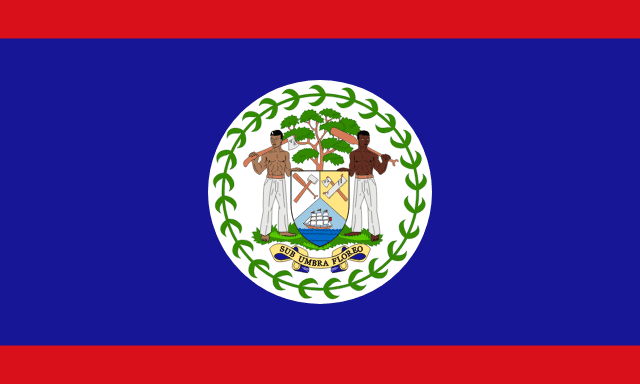
At a Glance
Alliances & Memberships
- UN
- CARICOM
- Commonwealth
- OAS
- SICA
Foreign Policy Overview
Bridge between Central America and Caribbean; ongoing Guatemala territorial dispute (ICJ).
Key Positions on Major Issues
Climate action; Belize-Guatemala ICJ case; marine conservation.
UN Voting Record Notes
CARICOM/AOSIS aligned.
Economy & Trade
Belize's economy is highly dependent on agriculture, services, and tourism, with tourism contributing approximately 40% of the GDP. Key exports include cane sugar, bananas, citrus, and marine products, while imports are dominated by manufactured goods, fuels, and chemicals. The currency is the Belizean Dollar (BZD), pegged to the USD at 2:1. Major trading partners include the United States, the United Kingdom, Mexico, and China.
Military & Security
The Belize Defence Force (BDF) is a small professional force focused primarily on border security, counter-narcotics, and disaster relief. Defense spending remains modest at roughly 1.1% of GDP. Belize maintains a vital defense cooperation agreement with the United Kingdom, which includes the British Army Training Support Unit Belize (BATSUB). The nation is a non-nuclear state and a signatory to the Treaty of Tlatelolco, prioritizing multilateral diplomacy over military expansion.
Recent History
Since gaining independence in 1981, Belize has focused on consolidating its democratic institutions and navigating a long-standing territorial dispute with Guatemala. The last 30 years have seen transitions between the PUP and UDP parties, largely maintaining a stable foreign policy. In 2019, Belizeans voted in a referendum to take the Guatemalan claim to the International Court of Justice (ICJ), a case currently in deliberation. The country has pivoted toward 'Blue Economy' initiatives, notably restructuring its national debt through the Blue Bond for Ocean Conservation in 2021. Recent foreign policy has prioritized climate advocacy and regional integration through CARICOM and SICA.
International Memberships
- United Nations (UN)since 1981
Strong advocate for small island developing states (SIDS).
- CARICOMsince 1974
Active member of the Caribbean Community; host of the Caribbean Community Climate Change Centre.
- SICA (Central American Integration System)since 2000
Full member, bridging the gap between Central America and the Caribbean.
- Commonwealth of Nationssince 1981
Maintains strong post-colonial ties and legal frameworks.
- Organization of American States (OAS)since 1991
Critical partner for regional development and hemispheric security.
MUN Negotiation Profile
CARICOM / G77 + China / AOSIS (Alliance of Small Island States)
Multilateralist, consensus-seeking, and legalistic; frequently leverages international law regarding territorial integrity.
- Unconditional preservation of sovereign borders against Guatemalan claims.
- No reduction in climate financing for Small Island Developing States (SIDS).
- Opposition to any measures infringing upon CARICOM regional sovereignty.
- "The urgent necessity for 'Loss and Damage' funding mechanisms for climate-vulnerable nations."
- "The resolution of the border dispute with Guatemala through the International Court of Justice (ICJ)."
- "Debt-for-nature swaps as a viable model for sustainable development (pioneered by Belize's Blue Bond)."