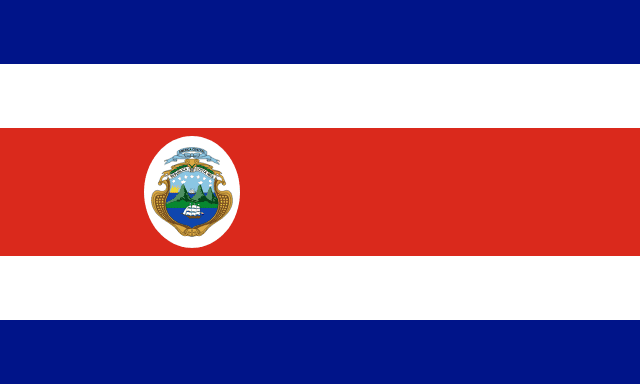
At a Glance
Alliances & Memberships
- UN
- OAS
- SICA
- CELAC
Foreign Policy Overview
No standing army (since 1948); environmental leader; hosts Inter-American Court of Human Rights.
Key Positions on Major Issues
Demilitarization; renewable energy (~99%); human rights; pro-Ukraine.
UN Voting Record Notes
Strongly aligns with Western liberal-democratic bloc.
Economy & Trade
Costa Rica's GDP is driven by high-value services, medical device manufacturing, and eco-tourism, transitioning from a traditional agricultural base. Key exports include orthopedic appliances, bananas, and coffee, with the United States serving as the primary trading partner (approx. 40% of exports). The currency is the Costa Rican Colón (CRC), and the nation has recently integrated into the OECD, emphasizing fiscal responsibility and green growth. Inflation remains relatively low compared to regional peers, focused on a 'Decarbonization Plan' to achieve net-zero by 2050.
Military & Security
Costa Rica is unique for having constitutionally abolished its standing military in 1949, diverting funds toward education and healthcare. Security is maintained by the Public Force (Fuerza Pública), a civil police force focusing on border patrol and counter-narcotics. It relies on the Inter-American Treaty of Reciprocal Assistance (Rio Treaty) and international law for national defense. Currently, it faces challenges from regional drug trafficking corridors and seeks international cooperation for maritime security without remilitarizing.
Recent History
The last 30 years in Costa Rica have been defined by economic diversification and a commitment to environmental leadership. Following the 1980s debt crisis, the country successfully rebranded as a global hub for eco-tourism and high-tech medical manufacturing. The 1987 Arias Peace Plan significantly bolstered its diplomatic prestige, leading to decades of stability while neighbors faced civil unrest. Recent administrations have focused on an ambitious National Decarbonization Plan and navigating the migration crisis spurred by instability in Nicaragua and Venezuela. In 2021, Costa Rica became the first Central American country to join the OECD, signaling a commitment to global governance standards. Current policy is heavily colored by the 'Triple Crisis' of climate change, biodiversity loss, and pollution.
International Memberships
- OECD (Organization for Economic Cooperation and Development)since 2021
Only the fourth Latin American member; reflects high standards in governance.
- Central American Integration System (SICA)since 1991
Central to regional trade and economic integration; founding member.
- Organization of American States (OAS)since 1948
Active participant in the Inter-American Human Rights System.
- United Nations (UN)since 1945
Consistently advocates for disarmament and environmental protections.
MUN Negotiation Profile
Western-aligned/Latin American Liberal Democracies (GRULAC)
Diplomatic, multilateralist, and mediation-focused; often acts as a 'bridge builder' or 'moral conscience' in committees.
- Any proposal suggesting the re-establishment of standing armies or military interventionism.
- Weakening of international climate agreements or the Paris Accord standards.
- Rollbacks on Universal Human Rights protections or LGBT+ rights.
- "The prioritization of 'Human Security' over traditional state/military security."
- "The urgent necessity of climate reparations and debt-for-nature swaps for developing nations."
- "Global nuclear disarmament and the promotion of the Treaty on the Prohibition of Nuclear Weapons (TPNW)."