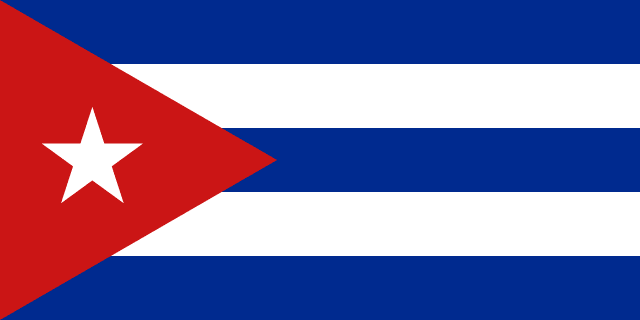
At a Glance
Alliances & Memberships
- UN
- ALBA
- CELAC
- G77
- Non-Aligned (chair 2023-24)
Foreign Policy Overview
Anti-US embargo central; close ties Russia, China, Venezuela, Iran; Global South leader.
Key Positions on Major Issues
End US embargo (annual UNGA resolution wins ~185-2); anti-imperialist; pro-Palestine.
UN Voting Record Notes
Consistently anti-US; pro-Russia/China; champion of G77 positions.
Economy & Trade
Cuba's economy is a primarily state-controlled system dominated by the services sector, particularly healthcare exports and tourism, though it has recently expanded the role of small and medium-sized private enterprises (MSMEs). The nation relies heavily on imports for refined petroleum and food, with key trade partners including China, Spain, Russia, and Venezuela. The economy is currently transitioning through severe inflation following the 2021 unification of its dual-currency system into the Cuban Peso (CUP). Major exports include nickel, cane sugar, tobacco (cigars), and pharmaceutical products.
Military & Security
The Revolutionary Armed Forces (FAR) maintain a defensive doctrine known as 'War of the Entire People,' intended to make any foreign occupation unsustainable. While personnel numbers have decreased since the Cold War, Cuba remains an influential intelligence and military partner for Russia and China in the Western Hemisphere. Cuba does not possess nuclear weapons and is a signatory to the Treaty of Tlatelolco, establishing Latin America as a nuclear-weapon-free zone. Defense spending is obscured by state budget structures but remains a priority for regime stability.
Recent History
Following the collapse of the Soviet Union, Cuba entered the 'Special Period,' forcing economic austerity and a pivot toward Venezuelan oil subsidies under Fidel Castro. The 2010s saw a brief 'thaw' in relations with the United States under the Obama administration, which was largely reversed during the Trump administration's 'Maximum Pressure' campaign. In 2018, Miguel Díaz-Canel succeeded Raúl Castro, marking the first time in 60 years a Castro did not hold the presidency, though the Communist Party (PCC) remains the sole legal party. Widespread protests in July 2021 (11J) reflected public frustration over economic shortages and healthcare during the pandemic. Recently, Cuba has deepened its strategic and military cooperation with Russia and China to offset the impact of renewed US sanctions.
International Memberships
- United Nations (UN)since 1945
Founding member; active in G77+China leadership.
- Organization of American States (OAS)since 1948
Excluded from 1962-2009; Cuba currently chooses not to participate in the organization despite the lifting of the suspension.
- ALBA-TCPsince 2004
Leading member advocating for regional integration without US influence.
- Group of 77 (G77)since 1964
Active member advocating for the interests of the Global South.
MUN Negotiation Profile
Non-Aligned Movement (NAM) / G77 / ALBA-TCP
Principled, anti-imperialist, and highly vocal about sovereignty and non-interference. Cuba is known for its 'Medical Diplomacy' and building coalitions among developing nations to oppose Western-led sanctions.
- Lifting of the US Embargo (El Bloqueo) as a prerequisite for full normalization of relations.
- Opposition to 'Responsibility to Protect' (R2P) being used as a pretext for intervention in sovereign states.
- Any inclusion of Cuba on 'State Sponsors of Terrorism' lists which restricts international finance.
- "The extraterritorial application of the US Helms-Burton Act violates international law and the UN Charter."
- "Global South debt relief is essential for meeting sustainable development goals."
- "Democratization of the UN Security Council to include more representation from Africa and Latin America."