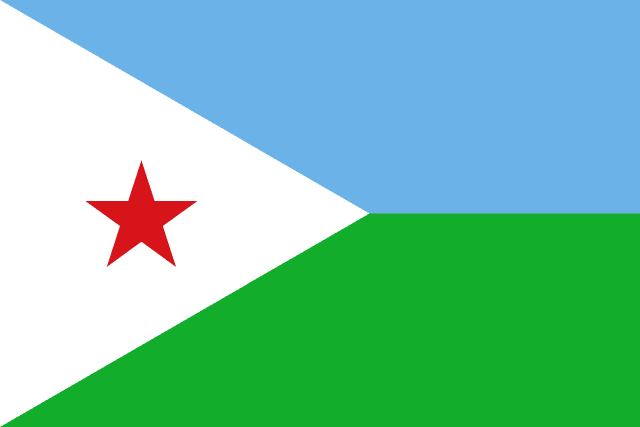
At a Glance
Alliances & Memberships
- UN
- AU
- Arab League
- OIC
- IGAD
Foreign Policy Overview
Hosts US, French, Chinese, Japanese, Italian military bases; strategic location at Bab-el-Mandeb; Red Sea security amid Houthi attacks.
Key Positions on Major Issues
Red Sea freedom of navigation; Somalia stability; Ethiopia transit.
UN Voting Record Notes
African/Arab consensus; pragmatic non-aligned.
Economy & Trade
Djibouti's economy is heavily reliant on its strategic location at the Bab el-Mandeb strait, with services (port and logistics) accounting for over 75% of GDP. Key industries include port services, transit trade for landlocked Ethiopia, and the rental of military bases to foreign powers. The currency is the Djiboutian Franc (DJF), which is pegged to the US Dollar. Major trade partners include China, Ethiopia, the UAE, and France, with China financing significant infrastructure projects under the Belt and Road Initiative.
Military & Security
Djibouti maintains a modest national force of approximately 10,000–15,000 active personnel but derives its primary security from hosting foreign military bases (USA, China, France, Japan, and Italy). Defense spending is roughly 4-5% of GDP, primarily focused on border security and counter-terrorism against Al-Shabaab influences from neighboring Somalia. The nation is a non-nuclear state and adheres to the Treaty of Pelindaba (African Nuclear-Weapon-Free Zone). Its military doctrine revolves around 'strategic rental,' leveraging its geography to ensure international protection and economic rent.
Recent History
Following independence from France in 1977, Djibouti’s modern political landscape has been dominated by President Ismaïl Omar Guelleh, in power since 1999. The last 30 years have seen the country transform into a global logistics hub, notably with the 2017 opening of China's first overseas military base. Relations with Eritrea were strained by a border conflict in 2008, though a 2018 peace agreement facilitated by Saudi Arabia helped normalize ties. Djibouti has recently navigated the complex Tigray conflict in Ethiopia, maintaining neutrality despite deep economic ties to Addis Ababa. The nation remains a critical node in the global 'War on Terror' as the site of Camp Lemonnier, the only permanent US base in Africa.
International Memberships
- Intergovernmental Authority on Development (IGAD)since 1986
Host to the Secretariat of the Intergovernmental Authority on Development.
- League of Arab Statessince 1977
Active participant in regional security and Arab economic integration.
- African Union (AU)since 1977
Focuses on regional infrastructure and continental integration.
- Organisation of Islamic Cooperation (OIC)since 1978
Active in the OIC's efforts regarding Islamic finance and regional stability.
MUN Negotiation Profile
Non-Aligned / Pro-Multilateralism (balancing Western and Chinese interests).
Pragmatic and transactional; Djibouti often acts as a mediator or a neutral host for regional negotiations.
- Any infringement on the sovereignty of the Port of Doraleh or its maritime claims.
- Moves to recognize Somaliland's independence prior to a negotiated settlement with Somalia.
- Reductions in developmental aid linked to its hosting of foreign military installations.
- "The necessity of protecting freedom of navigation in the Bab el-Mandeb strait from Houthi or pirate interference."
- "Equitable distribution of international maritime trade profits to shore up developing coastal nations."
- "The urgent need for climate adaptation funding for arid nations in the Horn of Africa."