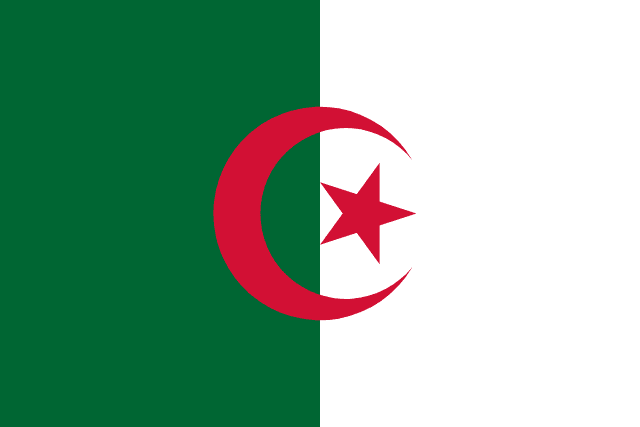
At a Glance
Alliances & Memberships
- UN
- AU
- Arab League
- OPEC
- OIC
- Non-Aligned Movement
Foreign Policy Overview
Non-aligned tradition; strong ties with Russia (arms) and China; tense relations with Morocco; major gas supplier to Europe.
Key Positions on Major Issues
Champions Western Sahara self-determination (Polisario); strongly pro-Palestine; opposes foreign military intervention.
UN Voting Record Notes
Often abstains on Russia-Ukraine; consistently votes pro-Palestine.
Economy & Trade
Algeria's economy is heavily dominated by the hydrocarbon sector, with oil and gas accounting for approximately 90% of export revenues and nearly 20% of GDP. The government uses the Algerian Dinar (DZD) and is currently focused on the 'Economic Recovery Plan' to diversify into mining, renewables, and agriculture. Major trade partners include Italy, France, Spain, and China, with Italy recently becoming a primary gas recipient following the 2022 Transmed pipeline expansions. In 2024-2025, Algeria has aggressively pursued BRICS+ partnership and membership to reduce dependence on Western financial systems.
Military & Security
Algeria maintains the largest defense budget in Africa, exceeding $21 billion in 2024, primarily focused on modernization and counter-terrorism. The People's National Army (ANP) relies heavily on Russian hardware but has recently diversified procurement from China and Turkey. Algeria follows a doctrine of non-interference and strictly prohibits the deployment of troops abroad except under specific UN/AU mandates, maintaining a non-nuclear status under the NPT. Strategic tensions remain high on the western border with Morocco over the Western Sahara conflict.
Recent History
The last 30 years in Algeria were shaped by the 'Black Decade' civil war in the 1990s, which ended with the Charter for Peace and National Reconciliation in 2005. Following the 20-year presidency of Abdelaziz Bouteflika, the 2019 'Hirak' mass protest movement led to his resignation and the election of President Abdelmadjid Tebboune. Under Tebboune, Algeria has adopted a 'New Algeria' foreign policy, reasserting itself as a regional mediator in Mali and Libya. Relations with France remain volatile due to colonial-era grievances, while the 2022 rupture of the 20-year friendship treaty with Spain over Western Sahara highlights the centrality of the Sahrawi issue. In 2024, Algeria's role as a non-permanent UNSC member has focused on securing a ceasefire in Gaza and addressing Sahelian instability.
International Memberships
- United Nations (UN)since 1962
Leading voice in the Arab Group and African Union. Currently serving as a Non-Permanent Member of the UN Security Council (2024-2025).
- OPECsince 1969
Founding member and major energy producer influencing global oil prices.
- African Union (AU)since 1963 (as OAU)
Host of the ALC (African Logistics Center) and key proponent of 'African solutions to African problems'.
- Arab Leaguesince 1962
Active participant in regional security and economic coordination; outspoken supporter of the Palestinian cause within the league.
MUN Negotiation Profile
Non-Aligned Movement (NAM) / African Bloc / Arab League. Often acts as a bridge between the Global South and the West on energy, but aligns with Russia/China on sovereignty issues.
Principled and legalistic; emphasizes territorial integrity, decolonization, and the UN Charter. Known for a 'tough' diplomatic stance, particularly regarding sovereignty.
- Any recognition of Moroccan sovereignty over Western Sahara.
- Foreign military intervention in Libya or the Sahel without Malian/Libyan state consent.
- Normalization of relations with Israel (Anti-normalization is a constitutional priority).
- "Support for the self-determination of the Sahrawi people through a UN-monitored referendum."
- "Reforming the UN Security Council to include permanent African representation (The Ezulwini Consensus)."
- "Defending the sovereignty of the Palestinian state with East Jerusalem as its capital."