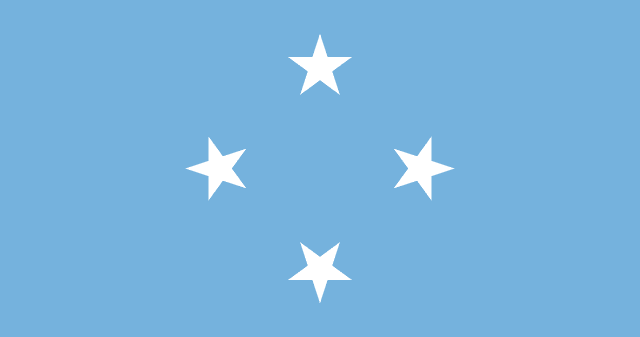
At a Glance
Alliances & Memberships
- United States (Compact of Free Association)
- Japan
- Australia
- Philippines
Foreign Policy Overview
The Federated States of Micronesia (FSM) maintains a foreign policy deeply rooted in its Compact of Free Association (COFA) with the United States, which grants the US responsibility for defense and provides significant economic assistance. This relationship heavily influences FSM's diplomatic posture, aligning it closely with US interests on many international issues while simultaneously pursuing sovereign engagement. Beyond the COFA, FSM prioritizes strong bilateral ties with regional partners such as Japan, Australia, and New Zealand, crucial for development aid and regional stability. Environmental diplomacy, particularly concerning climate change and rising sea levels, is at the forefront of its foreign policy, advocating robust international action. FSM actively participates in regional forums like the Pacific Islands Forum, aiming to strengthen regional solidarity and address shared challenges.
Key Positions on Major Issues
Climate: Micronesia is extremely vulnerable to climate change, particularly rising sea levels and extreme weather events. Its position is consistently vocal and urgent, advocating for immediate and substantial global emissions reductions, increased climate finance for adaptation and loss and damage, and international support for vulnerable island nations. Security: Relying on the US for defense under the COFA, Micronesia's security concerns often center on maritime security, illegal fishing, and regional stability. It supports international efforts to uphold the rule of law in the maritime domain and is wary of actions that could destabilize the Pacific region, emphasizing peaceful resolution of disputes. Human Rights: Micronesia generally aligns with international human rights norms and principles. Its focus is often on rights related to environmental displacement, indigenous rights, and the impacts of climate change on livelihoods and culture. It advocates for the protection of human dignity and equitable development. Trade: Micronesia's economy is largely driven by subsistence agriculture and fishing, with significant financial assistance from the US. Its trade policy seeks to expand market access for its limited exports, primarily fish, and secure favorable trade terms that support sustainable development and reduce reliance on imports. It participates in regional trade agreements to foster economic growth. Regional: As a small island developing state in the Pacific, Micronesia places immense importance on regional cooperation. It actively engages with the Pacific Islands Forum and other regional bodies to address shared challenges such as climate change, fisheries management, and sustainable development. It seeks to maintain a united front with fellow Pacific island nations on global issues.
UN Voting Record Notes
Micronesia's voting patterns in the UNGA reflect its strong alignment with the United States and its paramount concern for climate change. It consistently votes with the US on resolutions concerning humanitarian crises (e.g., often aligning with US positions on various human rights country situations). On Russia-Ukraine, FSM has consistently voted in favor of resolutions condemning Russian aggression and calling for an end to the conflict (e.g., UNGA ES-11 resolutions). Regarding Israel-Palestine, FSM tends to abstain or vote against resolutions critical of Israel, often aligning with the US. On climate change, FSM is a strong proponent of ambitious climate action, consistently voting in favor of resolutions that call for greater emissions reductions, climate finance, and support for vulnerable nations. It also supports resolutions promoting human rights and sustainable development.
Economy & Trade
GDP Composition: Services (approx. 50%), Agriculture (approx. 20%), Industry (approx. 10%), with a significant portion from foreign aid. Industries: tourism, construction, fish processing, craft production. Exports: fish (primarily tuna), betel nuts, some agricultural products. Imports: food, manufactured goods, machinery and equipment, fuel. Currency: US Dollar (USD). Top Trade Partners: United States, Japan, China, Australia, Guam.
Military & Security
Micronesia has no standing military. Defense is provided by the United States under the Compact of Free Association. Defense Spending: Minimal, primarily related to domestic law enforcement and maritime surveillance capabilities in cooperation with the US Coast Guard. Alliances: Exclusively with the United States via the Compact of Free Association. Nuclear/WMD Status: Non-nuclear state, signatory to the Treaty on the Non-Proliferation of Nuclear Weapons and the Treaty of Rarotonga (South Pacific Nuclear Free Zone Treaty). Doctrine: Relies on the US for external defense; internal security focuses on maritime surveillance, law enforcement, and disaster response.
Recent History
Since gaining independence in 1986 and entering into the Compact of Free Association with the US, Micronesia's recent history has been defined by its efforts to balance national sovereignty with its deep reliance on the COFA for economic development and security. The early 2000s saw renegotiations of the COFA, extending economic assistance and solidifying defense ties. A persistent challenge has been the struggle for economic self-sufficiency, with ongoing efforts to diversify beyond subsistence agriculture and fishing, and to develop tourism. Environmental concerns, especially climate change, have increasingly dominated the national agenda in the last two decades, with FSM becoming a leading voice in international climate advocacy due to the existential threat posed by rising sea levels. Politically, FSM has maintained a stable democratic system, navigating periodic leadership transitions and focusing on domestic development and managing its unique relationship with the US.
International Memberships
- United Nations (UN)since 1991
Joined after independence to engage in global diplomacy and seek international support.
- Pacific Islands Forum (PIF)since 1987
Key regional body for political and economic cooperation among Pacific island nations.
- Secretariat of the Pacific Community (SPC)since 1983
Regional organization providing scientific and technical expertise to support development.
- Alliance of Small Island States (AOSIS)since Early 1990s
Coalition of low-lying coastal and small island countries advocating on climate change issues.
- International Monetary Fund (IMF)since 1993
Provides financial assistance and promotes international monetary cooperation.
- World Banksince 1993
Offers financial and technical assistance to developing countries worldwide.
MUN Negotiation Profile
Generally aligned with Small Island Developing States (SIDS) and often with the United States due to the Compact of Free Association. Strong advocate for the Pacific Islands Forum solidarity.
Principled and persistent, emphasizing moral authority and existential threat regarding climate change. Seeks consensus within SIDS and regional blocs. Willing to compromise on non-core issues if it advances climate action or sustainable development.
- Any proposals that downplay the urgency or severity of climate change and sea-level rise.
- Measures that undermine national sovereignty or traditional fishing rights.
- Policies that fail to recognize the special vulnerabilities and needs of Small Island Developing States (SIDS).
- Any initiatives that negatively impact the Compact of Free Association with the United States.
- "The Federated States of Micronesia faces an existential threat from climate change; our very survival depends on immediate and decisive global action."
- "As a large ocean state, the sustainable management of our marine resources is paramount to our economic security and cultural heritage."
- "International cooperation and the upholding of multilateralism are essential for addressing global challenges, especially for small island nations like ours."
- "We urge all member states to recognize and support the special circumstances and vulnerabilities of Small Island Developing States in all development frameworks."
- "Our partnership with the United States, through the Compact of Free Association, remains vital for our security and economic stability, allowing us to focus on sustainable national development."