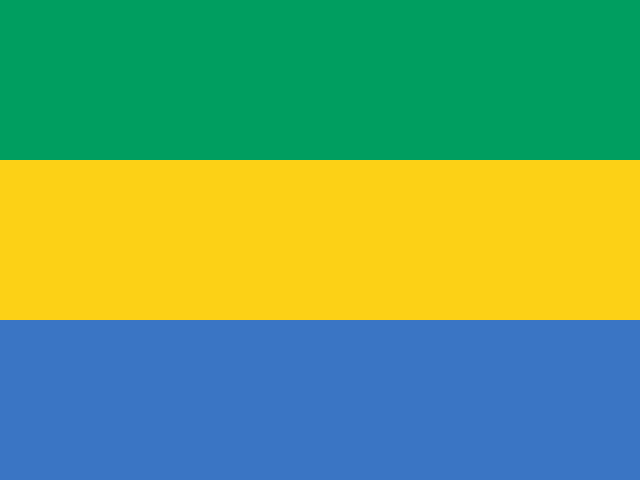
At a Glance
Alliances & Memberships
- UN
- AU (suspended/restored)
- ECCAS
- OPEC
- OIF
- Commonwealth
Foreign Policy Overview
Post-Bongo dynasty; transition toward elections; oil and rainforest economy.
Key Positions on Major Issues
Transition legitimacy; rainforest conservation (Congo Basin).
UN Voting Record Notes
African consensus; abstains on Russia.
Economy & Trade
Gabon's economy is heavily dependent on petroleum, which accounts for roughly 80% of exports and 45% of GDP. While a member of OPEC, the country is attempting to diversify through the 'Emerging Gabon' Strategic Plan, focusing on manganese mining and sustainable timber processing in the Nkok Special Economic Zone. The currency is the Central African CFA franc (XAF), and top trade partners include China, India, and France. Despite high GDP per capita relative to the region, wealth inequality remains a significant challenge.
Military & Security
The Gabonese Armed Forces (Forces Armées Gabonaises) consist of approximately 5,000 active personnel, traditionally focused on internal security and presidential protection. Since the August 2023 coup led by General Brice Oligui Nguema, the military maintains a dominant role in domestic governance via the Committee for the Transition and Restoration of Institutions (CTRI). Gabon maintains a defense cooperation agreement with France, though the presence of French troops is under periodic review. The country is a non-nuclear state and an active participant in regional maritime security initiatives in the Gulf of Guinea.
Recent History
Gabon's modern political landscape was dominated by the Bongo family for 56 years, beginning with Omar Bongo (1967–2009) and followed by Ali Bongo Ondimba. In August 2023, shortly after a disputed election, the military seized power in a bloodless coup, installing General Brice Oligui Nguema as transitional president. This ended the Bongo dynasty and led to Gabon's suspension from the African Union and the Commonwealth. The transitional government has since been drafting a new constitution and has scheduled elections for late 2025. Internationally, Gabon has shifted from a purely Francophone focus to a 'look-east' and 'look-Commonwealth' policy to diversify its diplomatic and economic dependencies. It remains a global leader in environmental diplomacy due to the preservation of its vast rainforests.
International Memberships
- African Union (AU)since 1963
Suspended in August 2023 following the military coup; currently undergoing a transition process.
- Commonwealth of Nationssince 2022
Joined to strengthen ties with the English-speaking world despite being a Francophone nation.
- ECCAS (Economic Community of Central African States)since 1983
Key regional economic bloc; Gabon currently hosts the headquarters in Libreville.
- OPEC (Organization of the Petroleum Exporting Countries)since 1975
Active participant in oil production quotas; re-joined after a hiatus from 1995-2016.
MUN Negotiation Profile
Non-Aligned / Francophonie / Commonwealth African Bloc
Pragmatic and mediator-oriented; historically a regional 'stabilizer' currently focused on seeking international legitimacy for its transitional government.
- External interference in the timeline of the post-coup democratic transition.
- Sanctions that target the extractive industries (oil/manganese) essential for state survival.
- Infringement on sovereign rights to manage the Congo Basin rainforest resources.
- "The necessity of 'debt-for-nature' swaps to fund conservation efforts in the Congo Basin."
- "The importance of regional maritime cooperation to combat piracy in the Gulf of Guinea."
- "Advocating for a permanent African seat on the UN Security Council (Ezulwini Consensus)."