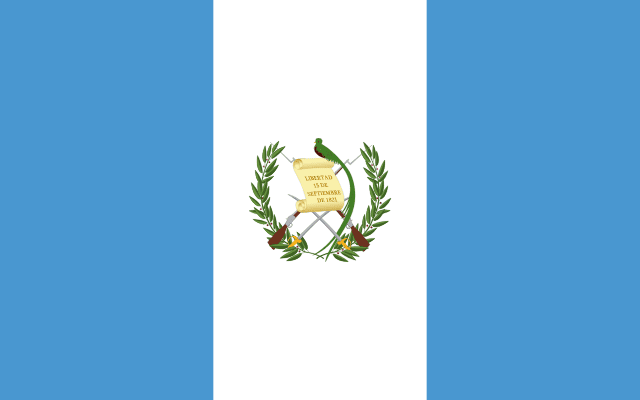
At a Glance
Alliances & Memberships
- UN
- OAS
- SICA
- CAFTA-DR
Foreign Policy Overview
Recognizes Taiwan; Belize ICJ territorial case; new Arévalo government anti-corruption focus.
Key Positions on Major Issues
Anti-corruption; Taiwan recognition; migration management with US.
UN Voting Record Notes
Generally Western-aligned; pro-Israel votes (embassy in Jerusalem).
Economy & Trade
Guatemala has the largest economy in Central America, characterized by a stable but low-growth GDP driven largely by agriculture (coffee, sugar, bananas) and remittances from the US, which account for nearly 20% of GDP. The currency is the Quetzal (GTQ), and the country maintains a strong manufacturing sector in textiles and food processing. Top trade partners include the United States, El Salvador, and Mexico, with the US-Central America Free Trade Agreement (CAFTA-DR) serving as its primary trade framework. Despite economic stability, high rates of poverty and income inequality remain persistent structural challenges.
Military & Security
The Guatemalan Armed Forces (Ejército de Guatemala) number approximately 21,000 active personnel with a focus on internal security, counter-narcotics, and disaster relief. Defense spending remains low at approximately 0.5% of GDP, conforming to the 1996 Peace Accords which limited the military's role in civil governance. Guatemala is a non-nuclear state and a signatory to the Treaty of Tlatelolco. The country maintains a close security partnership with the United States regarding border control and transnational organized crime.
Recent History
Following the 1996 Peace Accords that ended a 36-year civil war, Guatemala transitioned into a period of fragile democratic consolidation. The 2010s were marked by the historic work of the CICIG (International Commission against Impunity in Guatemala), which led to the resignation and arrest of President Otto Pérez Molina in 2015. However, later administrations faced criticism for dismantling anti-corruption efforts and weakening the rule of law. The 2023 election of Bernardo Arévalo, a reformist, marked a significant shift toward anti-corruption and social justice, despite intense legal challenges from entrenched political elites. Current foreign policy is defined by a re-alignment with the United States on democratic integrity and a continued territorial claim over large portions of Belize.
International Memberships
- United Nations (UN)since 1945
Founding member; significant participation in peacekeeping (MINUSCA).
- Organization of American States (OAS)since 1948
Core regional political body; active in the Inter-American Democratic Charter.
- SICA (Central American Integration System)since 1991
Primary mechanism for Central American economic and political integration.
- World Trade Organization (WTO)since 1995
Committed to trade liberalization and intellectual property standards.
MUN Negotiation Profile
Pro-Western / Global South / Pro-Taiwan
Pragmatic and multilateral, often aligning with the G77 and the 'Grulac' regional group. Frequently acts as a bridge between US interests and Latin American perspectives.
- Non-recognition of Guatemalan sovereignty over the Belize territorial dispute (pending ICJ resolution).
- Any infringement on the constitutional democratic order by international bodies.
- Reduction of US-led aid for migration containment without development investment.
- "Advocating for the 'Root Causes' approach to migration, focusing on economic development and anti-corruption."
- "Strong support for Taiwan's participation in international forums as one of its few remaining diplomatic allies."
- "Promoting regional climate resilience, specifically for the 'Dry Corridor' affected by extreme weather cycles."