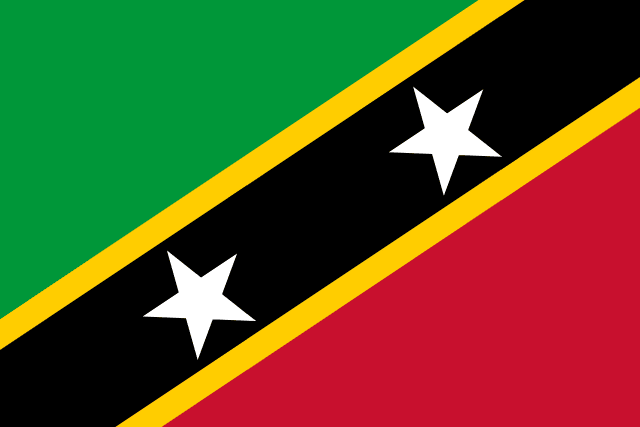
At a Glance
Alliances & Memberships
- UN
- CARICOM
- OECS
- Commonwealth
- OAS
- AOSIS
Foreign Policy Overview
Citizenship-by-investment economy; CARICOM bloc; climate-vulnerable.
Key Positions on Major Issues
Climate; CBI program reform; reparations.
UN Voting Record Notes
CARICOM/AOSIS aligned.
Economy & Trade
The economy of Saint Kitts and Nevis is one of the highest per capita in the Caribbean, driven primarily by tourism, export-oriented manufacturing, and the 'Citizenship by Investment' (CBI) program. The currency is the East Caribbean Dollar (XCD), pegged to the USD. Agriculture, once dominated by sugar until 2005, now focuses on diversified crops, while the manufacturing sector produces electronic components and garments for the US market. Top trade partners include the United States, Trinidad and Tobago, and the United Kingdom.
Military & Security
Saint Kitts and Nevis maintains the Saint Kitts and Nevis Defence Force (SKNDF), a small professional body focusing on maritime patrol, drug interdiction, and disaster relief. Defense spending remains a low percentage of GDP, with primary security cooperation facilitated through the Regional Security System (RSS) based in Barbados. The nation is a non-nuclear state and a signatory to the Treaty of Tlatelolco. National security doctrine prioritizes combating transnational organized crime and mitigating the impacts of climate-induced disasters.
Recent History
Following the 2005 closure of the state-run sugar industry due to falling prices, the Federation pivoted aggressively toward high-end tourism and its Citizenship by Investment (CBI) program. In 2015, the Team Unity coalition ended the 20-year rule of the Labour Party, focusing on fiscal transparency and infrastructure. The 2022 general elections saw a return of the Saint Kitts and Nevis Labour Party under Terrance Drew, who has prioritized the 'Sustainable Island State' initiative to transition to renewable energy. Foreign policy remains centered on 'Climate Diplomacy' and strengthening ties with Taiwan (ROC), being one of the few nations to maintain full diplomatic relations with Taipei. The nation continues to navigate the complexities of international tax scrutiny regarding its financial services sector.
International Memberships
- Organization of Eastern Caribbean States (OECS)since 1981
Founding member; central to regional integration and the OECS Union.
- Caribbean Community (CARICOM)since 1983
Active in climate advocacy (SIDS) and regional security.
- Organization of American States (OAS)since 1984
Key forum for regional political and legal cooperation.
- The Commonwealthsince 1983
Focus on post-colonial cooperation and development aid.
MUN Negotiation Profile
CARICOM / G-77 / AOSIS (Small Island Developing States)
Collaborative, focused on consensus-building, and moral high-ground diplomacy regarding climate justice.
- Violation of national sovereignty via foreign intervention in domestic tax/CBI policies.
- Any global climate agreement that fails to acknowledge 'Loss and Damage' for SIDS.
- Reductions in developmental aid or changes to 'Developing Country' status that ignore high vulnerability.
- "Urgent operationalization of the Loss and Damage Fund for small island nations."
- "International cooperation to stem the illegal flow of small arms from North America into the Caribbean."
- "The 'Multidimensional Vulnerability Index' (MVI) should replace GDP as the primary metric for concessional financing."