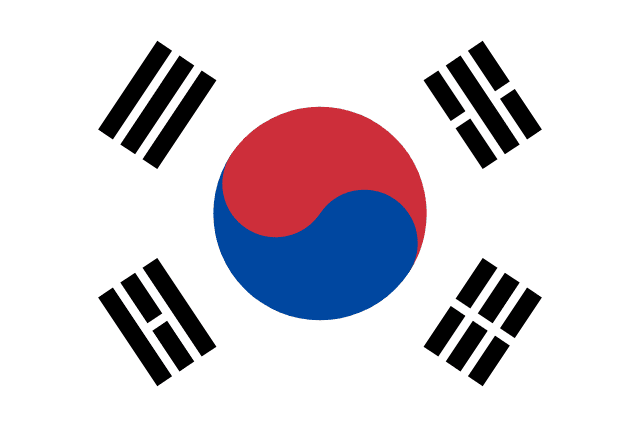
At a Glance
Alliances & Memberships
- ROK-US Mutual Defense Treaty
- AP4 (NATO Partners)
- IPEF (Indo-Pacific Economic Framework)
- G20
- OECD
- CPTPP (Application Pending)
Foreign Policy Overview
The Republic of Korea (ROK) pursues a 'Global Pivotal State' (GPS) doctrine under the Yoon Suk-yeol administration, aiming to expand its influence beyond the Korean Peninsula. Central to this is the 'Ironclad' alliance with the United States and the normalization of relations with Japan to counter North Korean nuclear threats. The ROK advocates for a rules-based international order, emphasizing liberal democracy, human rights, and maritime security in the Indo-Pacific. While China remains the largest trading partner, Seoul is increasingly aligning with Western security frameworks to diversify supply chains. The ROK also seeks a leading role in 'Green Growth' and digital governance.
Key Positions on Major Issues
SECURITY: Immediate, complete, verifiable, and irreversible denuclearization (CVID) of North Korea. Strengthening the US-ROK extended deterrence. CLIMATE: Carbon neutrality by 2050 via the 'Green New Deal'; expansion of nuclear energy and hydrogen technology. HUMAN RIGHTS: Consistent condemnation of North Korean human rights abuses; support for UN Commission of Inquiry recommendations. TRADE: Champion of free trade; active expansion of FTA networks; lead on semiconductor supply chain resilience (Chip 4 Alliance). REGIONAL: Preservation of Peace in the Taiwan Strait; freedom of navigation in the South China Sea.
UN Voting Record Notes
Consistent 'Yes' on resolutions condemning Russian aggression in Ukraine. 'Yes' or sponsor on all DPRK Human Rights resolutions. Votes with the United States on most security issues, though may abstain on some Middle East resolutions to maintain energy ties. Supportive of UNCLOS-related maritime stability resolutions.
Economy & Trade
GDP: $1.71 Trillion (nominal). Currency: South Korean Won (KRW). World's 13th largest economy. Sector Composition: Services (57%), Industry (33%), Agriculture (2%). Key Industries: Semiconductors (Samsung, SK Hynix), Automotive (Hyundai, Kia), Shipbuilding, Electronics, Steel. Export Partners: China (22.8%), USA (16.1%), Vietnam (8.9%). Import Partners: China, USA, Japan. Highly dependent on energy imports.
Military & Security
Active Personnel: 500,000; Reserves: 3,100,000. 2024 Defense Budget: $44.5 Billion. Nuclear Status: Non-nuclear state under NPT; protected by US 'Nuclear Umbrella'. Doctrine: 'Three-Axis' system (Kill Chain, KAMD, KMPR) designed to preemptively strike or retaliate against DPRK missile threats. Hosting of THAAD battery.
Recent History
The 1997 Asian Financial Crisis led to rapid neoliberal restructuring. The 2000s saw the 'Sunshine Policy' of engagement with the North, which cooled by 2010 after the sinking of the ROKS Cheonan. The 2016 impeachment of President Park Geun-hye and the subsequent Moon Jae-in administration (2017-2022) focused on ROK-DPRK summits. The current Yoon Suk-yeol administration (2022-present) has pivoted toward 'Value-Based Diplomacy,' strengthening the US alliance and restoring ties with Japan through the 2023 Camp David Accord.
International Memberships
- United Nationssince 1991
Permanent Representative to the UN; currently serving as a Non-Permanent Member of the UN Security Council (2024-2025).
- OECDsince 1996
Actively participates in Economic Policy Reform and Development Assistance Committee (DAC).
- APECsince 1989
Founding member of the regional security and economic forum.
- ASEAN+3since 1997
Full member; strategic partner in regional finance and security.
MUN Negotiation Profile
Western Bloc / JUSCANZ / AP4
Constructive, technocratic, and highly prepared. Prefers bilateral consensus-building before floor debate. Strong focus on 'middle-power diplomacy' to bridge gaps between developed and developing states.
- No recognition of North Korea as a nuclear-armed state.
- No reduction of USFK (US Forces Korea) presence without normalized relations.
- Non-interference in ROK sovereign defense decisions (e.g., THAAD deployment).
- No compromises on the integrity of the semiconductor supply chain or intellectual property.
- "The Republic of Korea stands as a testament to the power of the rules-based order, having transitioned from a recipient of UN aid to a major donor state."
- "We urge the international community to maintain a unified front in enforcing UN Security Council sanctions against the DPRK's unlawful provocations."
- "Seoul is prepared to lead the 'Green Transition' by sharing our world-class modular nuclear and hydrogen technologies with developing partners."
- "Human rights are universal; we cannot remain silent regarding the systemic abuses occurring north of the 38th parallel."
- "Security in the Indo-Pacific is indivisible from global security; we must ensure freedom of navigation remains absolute."