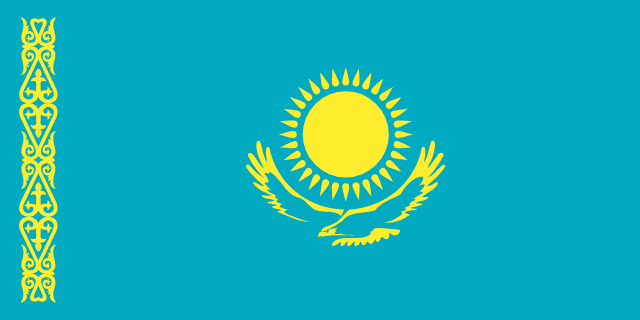
At a Glance
Alliances & Memberships
- CSTO (Collective Security Treaty Organization)
- EAEU (Eurasian Economic Union)
- SCO (Shanghai Cooperation Organization)
- Organization of Turkic States (OTS)
- CICA (Conference on Interaction and Confidence Building Measures in Asia)
Foreign Policy Overview
Kazakhstan adheres to a Multi-Vector Foreign Policy, balancing relations between Russia, China, the United States, and the European Union. Astana acts as a neutral mediator in international conflicts, exemplified by the Astana Process for Syria. The doctrine prioritizes regional stability in Central Asia and economic integration through the Silk Road Economic Belt. While maintaining a security alliance with Russia via the CSTO, Kazakhstan has maintained a neutral stance on the Ukraine conflict, refusing to recognize the annexation of Ukrainian territories. The state actively promotes global nuclear non-proliferation, drawing on its history of closing the Semipalatinsk test site. Kazakhstan seeks to position itself as a middle power and a bridge between East and West.
Key Positions on Major Issues
Climate: Committed to carbon neutrality by 2060; seeks international investment for green hydrogen and transitioning away from coal-dependence (70% of current power). Security: Strong proponent of the CICA process; supports the territorial integrity of all UN member states; advocates for a nuclear-weapon-free world. Human Rights: Undergoing "Second Republic" reforms following the 2022 unrest; abolished the death penalty in 2021; faces international scrutiny regarding freedom of assembly and media independence. Trade: Supports the expansion of the Middle Corridor (Trans-Caspian International Transport Route) to bypass sanctioned northern routes. Regional: Driving force behind Central Asian integration and water conservation efforts in the Aral Sea basin.
UN Voting Record Notes
Kazakhstan typically votes in alignment with the 'Global South' on economic issues and with the 'Eurasian Bloc' on some security matters. However, notably, Kazakhstan abstained on UN General Assembly resolutions condemning the Russian invasion of Ukraine (e.g., ES-11/1), refusing to vote 'No' despite Russian pressure. It consistently votes in favor of nuclear disarmament and against unilateral coercive measures (sanctions) that bypass the UNSC. In 2023, it supported resolutions on the 'Right to Food' and 'Promotion of International Cooperation' in human rights.
Economy & Trade
GDP Composition: Services (55%), Industry (34%), Agriculture (5%). Currency: Kazakhstani Tenge (KZT). Major Industries: Oil, coal, iron ore, manganese, chromite, lead, zinc, copper, titanium. Exports: Crude petroleum (over 50%), copper, radioactive chemicals (uranium), ferroalloys. Trade Partners: China (primary export destination), Russia (primary import source), Italy, Netherlands, South Korea. Kazakhstan is the world's leading producer of uranium (approx. 43% of global supply).
Military & Security
Active personnel: approx. 45,000. Military spending: ~1% of GDP. Doctrine: Defensive; emphasizes rapid reaction and counter-terrorism. Security Umbrella: Member of CSTO, providing a mutual defense clause with Russia. WMD Status: Voluntarily renounced the world's fourth-largest nuclear arsenal after the Soviet collapse; host to the IAEA Low Enriched Uranium (LEU) Bank. Relations: NATO Partnership for Peace member.
Recent History
Kazakhstan gained independence in 1991 under Nursultan Nazarbayev, who ruled for nearly three decades, focusing on economic liberalization and the 'Kazakhstan 2050' strategy. In 2019, Nazarbayev resigned, handing power to Kassym-Jomart Tokayev. January 2022 saw 'Tragic January,' where peaceful protests over fuel prices escalated into violent unrest and an attempted coup, leading to a brief CSTO intervention. Post-2022, Tokayev initiated 'Zhana Kazakhstan' (New Kazakhstan) reforms, amending the constitution to limit presidential terms and decentralize power. Externally, the 2022 invasion of Ukraine has forced Kazakhstan to navigate its relationship with Russia carefully, maintaining trade while adhering to international sanctions and upholding the territorial integrity of Ukraine.
International Memberships
- CSTOsince 1994 (Treaty signed 1992)
Founding member and key driver of regional security cooperation.
- Eurasian Economic Union (EAEU)since 2015
Critical for trade and economic integration with Russia and Belarus.
- Shanghai Cooperation Organization (SCO)since 2001 (founding member)
Focus on regional security and counter-terrorism.
- OSCEsince 1992
Consistent engagement in development and human rights dialogues.
- United Nationssince 1992 (UNSC non-permanent member 2017-2018)
Active participant in peacebuilding and non-proliferation committees.
MUN Negotiation Profile
Central Asian/Non-Aligned (leaning toward pragmatic multi-alignment)
Consensus-builder, pragmatic, neutral mediator. Prefers 'Bridge-building' roles and avoids escalatory rhetoric.
- Any challenge to the territorial integrity or sovereignty of Kazakhstan.
- Sanctions that target the energy transit infrastructure (Middle Corridor).
- Mandatory interference in domestic political transitions under the guise of democratization.
- Attempts to force a binary choice between Western and Eurasian alliances.
- "Kazakhstan stands as a champion of the global non-proliferation regime, having shuttered the Semipalatinsk site as an act of peace."
- "We advocate for a multi-polar world order where the voices of middle powers are not only heard but are central to the resolution of regional conflicts."
- "As a landlinked—not landlocked—state, my delegation emphasizes the vital importance of the Middle Corridor for global supply chain resilience."
- "We call upon our partners to support the 'Green Bridge' initiative to facilitate the transfer of sustainable technologies to developing economies."
- "My government remains committed to the principles of the UN Charter, particularly the sanctity of internationally recognized borders."