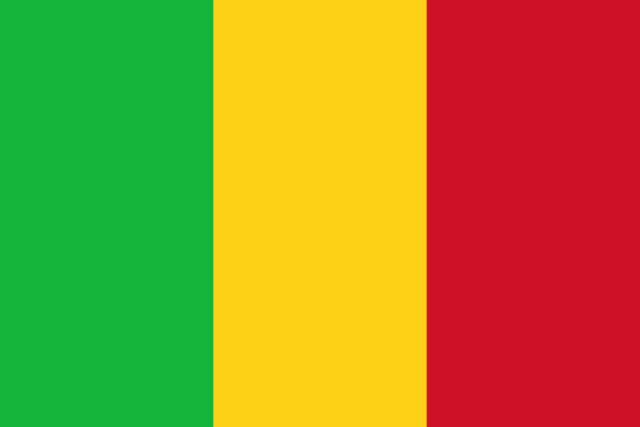
At a Glance
Alliances & Memberships
- UN
- Alliance of Sahel States (AES)
- OIC
Foreign Policy Overview
Withdrew from ECOWAS (2024); expelled French and UN (MINUSMA) forces; Wagner/Africa Corps replaced; deepening Russia ties.
Key Positions on Major Issues
Sovereignty; anti-French; pro-Russia; jihadist insurgency; Tuareg conflict resumed.
UN Voting Record Notes
Often votes with Russia or abstains.
Economy & Trade
Mali's economy is heavily dependent on agriculture and gold mining, with gold accounting for over 80% of total export earnings. Cotton is the primary agricultural export, though the country remains vulnerable to fluctuations in gold prices and erratic rainfall patterns. The currency is the West African CFA Franc (XOF), pegged to the Euro, though the current transitional government has expressed interest in a sovereign currency under the Alliance of Sahel States (AES). Major trade partners include China, the UAE (primary gold destination), and Ivory Coast.
Military & Security
The Malian Armed Forces (FAMa) have significantly expanded their operational capacity through a strategic pivot toward Russia, specifically utilizing the Wagner Group (now Africa Corps) for counter-insurgency. Defense spending has increased drastically to combat Jihadi-Salafist groups (JNIM and ISGS) and Tuareg separatist rebels in the north. Mali officially requested the withdrawal of UN peacekeepers (MINUSMA) in 2023, asserting that the mission failed to address the security crisis. The nation does not possess WMDs and focuses its doctrine on territorial integrity and "sovereign security" without Western interference.
Recent History
Since the late 1990s, Mali has transitioned from a model of democratic stability to a center of regional insecurity. A 2012 Tuareg rebellion and subsequent Islamist coup led to French military intervention (Operation Serval/Bakhane). However, persistent insecurity led to a 2020 coup d'état followed by a 'coup within a coup' in 2021 led by Colonel Assimi Goïta. Relations with France collapsed in 2022, leading to the total expulsion of French forces and a pivot to the Russian Federation. In 2023, Mali oversaw the termination of the UN’s MINUSMA mission and adopted a new constitution that strengthens the presidency and removes French as an official language. In 2024, Mali formally announced its exit from ECOWAS, signaling a permanent shift toward the Alliance of Sahel States.
International Memberships
- African Union (AU)since 1963
Currently suspended following the 2020/2021 coups.
- Economic Community of West African States (ECOWAS)since 1975
Suspended status; Mali announced its immediate withdrawal in Jan 2024 alongside Burkina Faso and Niger.
- Alliance of Sahel States (AES) / L'Alliance des États du Sahelsince 2023
Formed with Burkina Faso and Niger to create a collective defense and economic pact.
- Organisation internationale de la Francophonie (OIF)since 1970
Active participant in the Francophone diplomatic sphere, though relations with France are severed.
MUN Negotiation Profile
Pro-Russia / Alliance of Sahel States (AES) / Global South Non-Aligned (Revisionist)
Confrontational and sovereignty-focused; Mali utilizes a 'diplomacy of rupture' to challenge traditional Western-led international norms.
- Any proposal involving the return of French military presence or influence.
- Interventionist human rights oversight that bypasses Malian national courts.
- External interference in the transition timeline or domestic electoral processes.
- "The failure of multilateral peacekeeping (MINUSMA) necessitates African-led, sovereign security solutions."
- "Sanctions imposed by ECOWAS and Western bodies are 'illegal and inhumane' collective punishments."
- "Mali's right to choose its security partners (Russia/China) must be respected as a core tenet of Westphalian sovereignty."