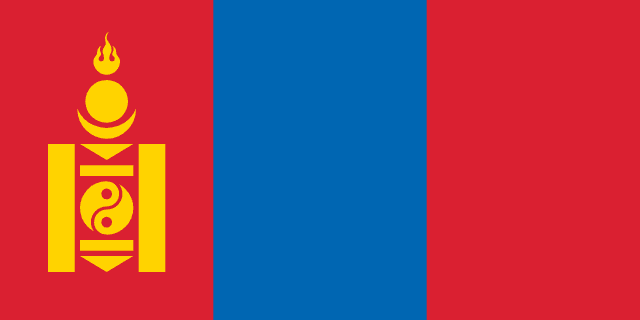
At a Glance
Alliances & Memberships
- UN
- OSCE (Partner for Co-operation)
- SCO (Observer)
- ASEAN Regional Forum (ARF)
- G77+China
- Non-Aligned Movement (NAM)
- APEC (Candidate)
Foreign Policy Overview
Mongolia's foreign policy is anchored in the 'Third Neighbor' doctrine, designed to maintain national sovereignty by cultivating deep ties with democratic nations (USA, Japan, EU, South Korea) while maintaining balanced, pragmatic relations with its two immediate neighbors, Russia and China. This policy aims to reduce economic dependence on any single neighbor through diversification. Mongolia promotes itself as a proactive, neutral mediator in regional security, exemplified by the Ulaanbaatar Dialogue on Northeast Asian Security. The nation strongly advocates for nuclear disarmament and remains a declared single-state nuclear-weapon-free zone (SNWFZ). Its posture is one of 'permanent neutrality' in practice, though not legally enshrined in the constitution, focusing on international law and the UN Charter. Relations are prioritized through the Comprehensive Strategic Partnerships held with both Beijing and Moscow.
Key Positions on Major Issues
CLIMATE: High vulnerability to desertification and 'dzud' (extreme winters). Proponent of the 'One Billion Trees' national campaign and active in UNCCD; pushed for the International Year of Rangelands and Pastoralists (2026). SECURITY: Strong supporter of UN Peacekeeping (top 20 contributor per capita). Host of the 'Khaan Quest' military exercises. Non-nuclear status is a core identity. HUMAN RIGHTS: Abolished the death penalty in 2017. Current focus on judicial reform and anti-corruption. Usually aligns with Western-style resolutions on civil liberties while maintaining a cautious tone on neighbors. TRADE: Landlocked Developing Country (LLDC) status is central; advocates for the 'Vienna Programme of Action' to improve transit and trade facilitation via Russia and China. REGIONAL: Mediator for the Korean Peninsula; Ulaanbaatar is one of the few capitals with cordial ties to both North and South Korea.
UN Voting Record Notes
Mongolia typically votes in favor of UNGA resolutions supporting territorial integrity and human rights, but frequently abstains on sensitive votes involving Russia or China to maintain diplomatic balance (e.g., abstained on ES-11/1 regarding Ukraine). It consistently votes for all resolutions related to nuclear disarmament and the rights of landlocked countries. It recently supported resolutions on the promotion of pastoralism and rangeland health.
Economy & Trade
GDP composition: Services (40%), Industry/Mining (38%), Agriculture (13%). Major Industries: Mining (copper, coal, molybdenum, gold, fluorspar), livestock, cashmere. Exports: Coal (50%+), Copper, Iron ore, Petroleum. Currency: Mongolian Togrog (MNT). Top Trade Partners: China (80-90% of exports), Russia (90% of fuel imports). Nominal GDP: ~$19.5 Billion.
Military & Security
Active personnel: approx. 10,000. Doctrine is purely defensive, focusing on UN Peacekeeping (MINUSMA, UNMISS) and border protection. Military spending is approx. 1% of GDP. No WMDs; status as a nuclear-weapon-free zone recognized by the P5 in 2012. Relies on Russia for hardware and the US/NATO for training and modernization.
Recent History
Since the 1990 Peaceful Democratic Revolution, Mongolia has successfully transitioned from a Soviet satellite to a vibrant democracy. The 1992 Constitution established a market economy. The 2010s saw a massive mining boom, particularly the Oyu Tolgoi copper-gold mine, which transformed the economy but led to debt challenges. In 2012, the UN P5 signed a declaration recognizing Mongolia’s nuclear-weapon-free status. Recent years have been marked by the 'Vision 2050' long-term development policy and efforts to balance energy dependence on Russia during the Ukraine conflict, while managing China’s 'Belt and Road' investments. Significant anti-corruption protests occurred in 2022 regarding coal theft, leading to legislative reforms.
International Memberships
- United Nationssince 1961
Foundational to 'Third Neighbor' strategy and global legitimacy.
- International Monetary Fund (IMF) / World Banksince 1991
Crucial for mineral export financing and infrastructure development.
- Shanghai Cooperation Organization (SCO)since 2004 (Observer)
First observer state; resists full membership to maintain neutrality/independence from bloc politics.
- OSCE (Partner for Co-operation)since 2012
Engages in security dialogue with European and North American partners.
- World Trade Organization (WTO)since 1997
Integration into the global rules-based trading system.
MUN Negotiation Profile
Non-Aligned / Global South / Pro-Western Democracy (Hybrid)
Pragmatic, bridge-builder, emphasis on international legal norms and sovereignty. Often acts as a mediator between Western interests and regional realities.
- Explicit condemnation of its immediate neighbors (Russia/China) in a manner that triggers economic retaliation.
- Any challenge to Mongolia’s status as a Single-State Nuclear-Weapon-Free Zone.
- Policies that restrict the transit rights of landlocked nations.
- Attempts to force Mongolia into a formal military alliance that violates its balanced 'Third Neighbor' doctrine.
- "As a Landlocked Developing Country, Mongolia reminds this committee that geographical constraints must not be barriers to sustainable trade and development."
- "Mongolia’s commitment to a nuclear-weapon-free world is not a mere policy, but a core pillar of our national security identity."
- "We call upon the international community to recognize the unique challenges of 'dzud' and climate-driven migration affecting pastoralist societies."
- "My delegation stands ready to serve as a neutral platform for dialogue, as we have done with the Ulaanbaatar Dialogue for Northeast Asian Security."
- "We urge for the full implementation of the Vienna Programme of Action to ensure fair transit for all LLDCs."