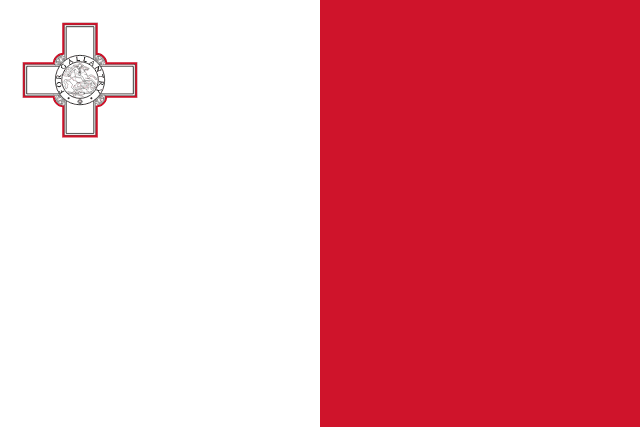
At a Glance
Alliances & Memberships
- European Union (EU)
- Commonwealth of Nations
- Eurozone
- Schengen Area Organization for Security and Co-operation in Europe (OSCE)
- Council of Europe
Foreign Policy Overview
Malta maintains a policy of constitutional neutrality, established in 1987, which prohibits participation in military alliances or the hosting of foreign military bases. Despite this, Malta is a robust proponent of European integration and follows the EU's Common Foreign and Security Policy (CFSP). Central to its doctrine is its role as a Mediterranean bridge-builder, focusing on maritime security, migration management, and regional stability. It maintains a 'Special Relationship' with Libya and promotes the Mediterranean as a 'Zone of Peace.' Relationships with the UK remain strong due to historical ties, while it increasingly aligns with the Med7 group (EU Mediterranean states). Security policy is focused on soft power, diplomacy, and international law rather than military force.
Key Positions on Major Issues
CLIMATE: Extreme vulnerability to sea-level rise and water scarcity; active proponent of the 'Climate Change as a Common Concern of Mankind' initiative at the UN. SECURITY: Focus on maritime security, human trafficking in the Mediterranean, and stabilization of Libya to prevent irregular migration flows. HUMAN RIGHTS: Global leader in LGBTQ+ rights (ranked top of ILGA-Europe Rainbow Index); strong emphasis on rule of law following 2017's Caruana Galizia case. TRADE: Supports the EU Single Market; emphasizes 'Blue Economy' sustainable maritime trade; vocal advocate for small island state exceptions in carbon taxation. REGIONAL: Strong supporter of the UfM (Union for the Mediterranean) and the 5+5 Dialogue.
UN Voting Record Notes
Consistently votes with the EU bloc in the UNGA (approx. 95% alignment). Votes in favor of resolutions condemning Russian aggression in Ukraine (supports ES-11/1, ES-11/6). Strong supporter of UNCLOS (Law of the Sea). Generally supports resolutions promoting LGBTQ+ rights and gender equality. On the UNSC, Malta has prioritized the Protection of Civilians and Children in Armed Conflict, notably sponsoring Resolution 2712 regarding the humanitarian situation in Gaza.
Economy & Trade
Advanced, high-income service economy. GDP Composition: Services (85%), Industry (10%), Agriculture (1%). Currency: Euro (EUR). Key Industries: Tourism, iGaming, Financial Services, Maritime Transshipment (Marsaxlokk Port), Pharmaceuticals. Trade Partners: Italy, Germany, France, UK, Singapore. Main Exports: Integrated circuits, refined petroleum, packaged medicaments. Main Imports: Mineral fuels, aircraft, machinery.
Military & Security
Armed Forces of Malta (AFM) consist of approx. 2,000 personnel. Primary roles: Border control, Search and Rescue (SAR), and fishery protection. Spending: Approx. 0.6% of GDP. Non-nuclear state; signatory to the TPNW (Treaty on the Prohibition of Nuclear Weapons). No formal military alliances due to Constitutional Neutrality (Art. 1, Sec. 3). Maintains partnership for peace status with NATO but does not seek membership.
Recent History
The last 30 years have seen Malta transition from a British-influenced post-colonial state to a central EU member. Key milestones include EU accession in 2004 and adoption of the Euro in 2008. The 2011 Arab Spring, particularly the Libyan Civil War, placed Malta at the forefront of the migration crisis and evacuation efforts. Domestically, the 2017 assassination of journalist Daphne Caruana Galizia sparked a period of institutional reform and international scrutiny on the rule of law. Since 2020, the government has focused on economic recovery post-COVID and positioning Malta as a tech/fintech hub. In 2023, Malta began its second term on the UN Security Council.
International Memberships
- European Unionsince 2004
Accession shifted Malta from a developing to an advanced economy status.
- United Nationssince 1964
Member of the Western European and Others Group (WEOG).
- Council of Europesince 1965
Key for human rights standards and Rule of Law monitoring.
- Commonwealth of Nationssince 1964
Maintains historical and cultural links with the UK and former colonies.
- UN Security Council (Non-permanent)since 2023
Elected for the 2023-2024 term, focusing on security and climate nexus.
MUN Negotiation Profile
EU/WEOG / Neutral Middle-Power
Mediation-focused, legalistic, multi-lateralist, and consensus-seeking. Focuses on drafting precise maritime and legal language.
- Any violation of Malta's Constitutional Neutrality or requirement to join a military alliance.
- Forced repatriation of refugees to unsafe ports (Principle of Non-refoulement).
- Infringement on national sovereignty regarding taxation (Corporate Tax Harmonization).
- Removal of special status for Small Island Developing States (SIDS) in climate funding.
- "As a Mediterranean nation, Malta reminds this assembly that the stability of North Africa is inseparable from the security of Europe."
- "Malta urges a collective, multilateral response to the climate crisis that recognizes the unique existential threat faced by island states."
- "We reaffirm our commitment to the rule of law and international maritime conventions as the only frameworks for resolving regional disputes."
- "My delegation calls for a humanitarian-first approach to migration, ensuring that the Mediterranean becomes a sea of life, not a graveyard."
- "Malta stands ready to act as a neutral mediator to foster dialogue between conflicting parties where others cannot."