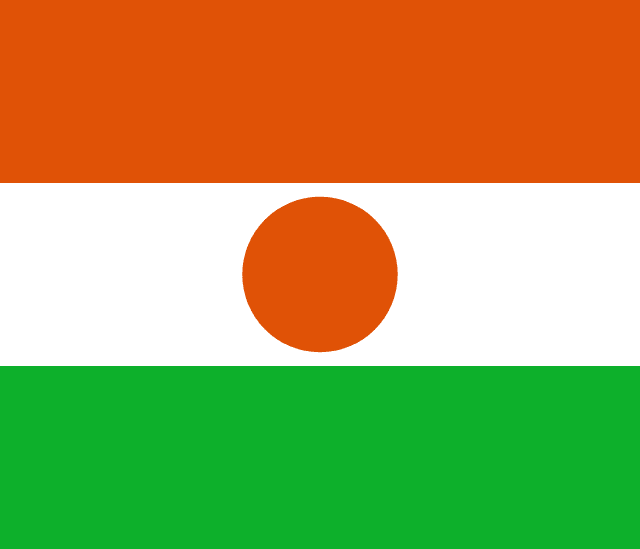
At a Glance
Alliances & Memberships
- UN
- Alliance of Sahel States (AES)
- OIC
Foreign Policy Overview
Withdrew from ECOWAS (2024); expelled French and US troops (2024); turned to Russia for security; uranium exports.
Key Positions on Major Issues
Anti-French/US sovereigntism; pro-Russia; jihadist insurgency.
UN Voting Record Notes
Often abstains or votes with Russia.
Economy & Trade
Niger's economy is heavily dependent on subsistence agriculture and the extraction of natural resources, particularly uranium and gold. Following the 2023 coup, the country faced severe regional sanctions that disrupted trade, though it has recently pivoted toward increased oil production via the Niger-Benin pipeline to bolster GDP. The currency remains the West African CFA Franc (XOF), and primary trade partners include France, China, and Nigeria. Despite significant mineral wealth, Niger remains one of the world's poorest nations with a high vulnerability to climate change and fluctuating commodity prices.
Military & Security
The Nigerien Armed Forces (FAN) consist of approximately 10,000–12,000 active personnel, now heavily focused on counter-insurgency against groups like JNIM and ISGS. Following the 2023 coup, the military junta (CNSP) ordered the withdrawal of French and US troops, pivoting toward Russia's Africa Corps for security assistance. Niger is a non-nuclear state and has increasingly centralized its defense doctrine around the 'Alliance of Sahel States' (AES) mutual defense pact. Defense spending has surged as a percentage of the budget to combat the escalating jihadist threat in the Tri-Border region.
Recent History
Since the 1990s, Niger has experienced several rounds of democratic transition interrupted by military coups, notably in 1996, 1999, and 2010. The 2021 election of Mohamed Bazoum marked the first peaceful democratic transfer of power, but this was overturned by a military coup in July 2023 led by General Abdourahamane Tchiani. In response to sanctions and condemnation from the West and ECOWAS, Niger’s current administration has pivoted sharply toward the 'Alliance of Sahel States' with Mali and Burkina Faso. This period is defined by the expulsion of French diplomatic and military missions and the pursuit of 'total sovereignty.' Current foreign policy is dictated by the CNSP (National Council for the Safeguard of the Homeland) with a focus on regional military cooperation outside of traditional frameworks.
International Memberships
- African Union (AU)since 1963
Suspended following the July 2023 coup d'état.
- Economic Community of West African States (ECOWAS)since 1975
Withdrew in January 2024 citing sovereignty concerns (effective 2025).
- Alliance of Sahel States (AES)since 2023
Founding member; central to current security and economic strategy.
- OHADAsince 1995
Active member; facilitates legal and economic integration.
MUN Negotiation Profile
Sovereignist / Pro-Multipolarity (shifting away from Western influence toward Russia/China)
Assertive, transactional, and highly protective of national sovereignty and non-interference.
- Foreign military presence without explicit CNSP authorization.
- Conditions on humanitarian or development aid regarding domestic political transitions.
- Interventionist policies by ECOWAS or Western powers.
- "The necessity of military-led transitions to ensure national security against terrorism."
- "The failure of traditional Western security partnerships in the Sahel region."
- "Right to exploit national resources (uranium/oil) without foreign interference."