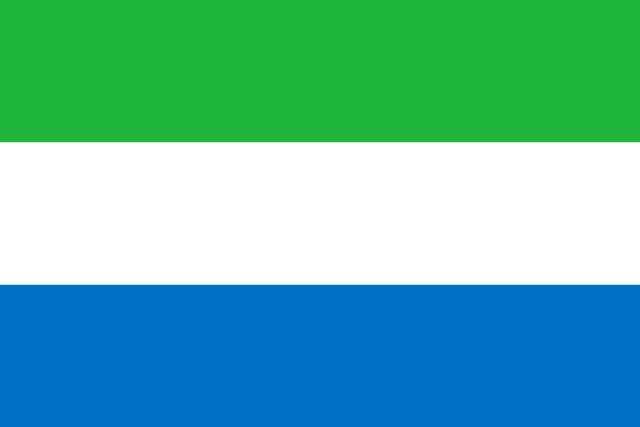
At a Glance
Alliances & Memberships
- UN
- AU
- ECOWAS
- Commonwealth
- OIC
- Mano River Union
Foreign Policy Overview
UNSC non-permanent member 2024-25 (championing African seats reform); ECOWAS chair 2024; recovering from civil war and Ebola.
Key Positions on Major Issues
Permanent African UNSC seats; democracy; FGM legislation.
UN Voting Record Notes
African consensus; pro-Palestine.
Economy & Trade
Sierra Leone's economy is heavily dependent on mineral extraction, particularly diamonds, iron ore, and rutile, which account for the majority of export earnings. Agriculture remains the largest employer, involving over 60% of the labor force and focusing on rice, palm oil, and cocoa. The country uses the Sierra Leonean Leone (SLL) and maintains primary trade partnerships with China, the European Union (specifically Belgium for diamonds), and neighboring West African states. Infrastructure development and high inflation remain significant macroeconomic challenges as the government seeks to diversify into tourism and sustainable fishing.
Military & Security
The Republic of Sierra Leone Armed Forces (RSLAF) consists of approximately 8,500 active personnel, focusing primarily on internal security and regional peacekeeping. Sierra Leone maintains no nuclear or WMD capabilities and is a signatory to the TPNW. Military doctrine has shifted from post-civil war reconstruction to active contribution to UN and AU peacekeeping missions (e.g., AMISOM/ATMIS). Defense spending is relatively low, and the country relies on security cooperation agreements with the UK and the United States for training and maritime patrol.
Recent History
Following the end of a decade-long civil war in 2002, Sierra Leone has successfully transitioned into a stable multi-party democracy through several peaceful transfers of power. The country faced a severe setback during the 2014-2016 Ebola outbreak, which devastated the healthcare system and economy. In 2018, Julius Maada Bio was elected president, focusing his first term on the 'Free Quality School Education' initiative. Recent years have been marked by efforts to address the legacy of the truth and reconciliation process while navigating global inflation and food insecurity. In 2023, President Bio was re-elected for a second term, though the election faced scrutiny from international observers regarding transparency. Today, Sierra Leone leverages its seat on the UN Security Council to advocate for African interests and global peacebuilding.
International Memberships
- Economic Community of West African States (ECOWAS)since 1975
Active participant in regional peacekeeping and economic integration via ECOWAS.
- United Nations (UN)since 1961
Focuses on sustainable development and post-conflict governance.
- United Nations Security Council (UNSC)since 2024
Currently serving as a non-permanent member (2024-2025).
- African Union (AU)since 1963
Engages in intra-African trade and solidarity initiatives.
MUN Negotiation Profile
African Group / G77 + China / NAM
Constructive, multilateralist, and mediation-focused; often acts as a bridge between regional powers and the West.
- Any violation of national sovereignty or interference in internal democratic processes.
- Reduction of UN Peacebuilding Fund allocations for post-conflict states.
- Attempts to bypass the Ezulwini Consensus regarding UNSC reform.
- "Advocating for the 'Ezulwini Consensus' to grant Africa two permanent seats on the UN Security Council."
- "Addressing the connection between climate change and regional security in the Sahel/West Africa."
- "Promoting the 'Medium-Term National Development Plan' as a model for post-conflict recovery."