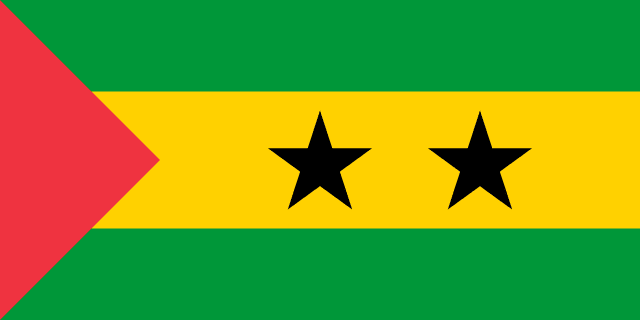
At a Glance
Alliances & Memberships
- UN
- AU
- ECCAS
- CPLP
- AOSIS
Foreign Policy Overview
Switched recognition from Taiwan to PRC (2016); offshore oil potential; cocoa exports.
Key Positions on Major Issues
Climate (SIDS); oil development; CPLP solidarity.
UN Voting Record Notes
African/AOSIS consensus.
Economy & Trade
São Tomé and Príncipe's economy is heavily dependent on agriculture, particularly cocoa exports, which account for over 80% of export earnings. The nation also relies significantly on international aid and tourism, while grappling with a fixed exchange rate to the Euro (STN) and high import costs for fuel and consumer goods. Recent explorations in the Joint Development Zone with Nigeria indicate potential offshore oil reserves, though commercial production remains a future prospect. Top trade partners include Portugal, Angola, and Spain, with the services sector increasingly contributing to the GDP composition.
Military & Security
The Armed Forces of São Tomé and Príncipe (FASTP) are small, focusing primarily on maritime surveillance and internal security with an estimated 600 active personnel. Defense spending is minimal, accounting for less than 1% of GDP, and the country maintains no nuclear or WMD capabilities. Security policy is defined by international partnerships, specifically with Portugal and the United States, to combat piracy and illegal fishing in the Gulf of Guinea. The nation follows a non-aggression doctrine and frequently participates in regional maritime exercises like Obangame Express.
Recent History
Since the transition to multi-party democracy in 1991, São Tomé and Príncipe has maintained a reputation as one of Africa's most stable democracies, despite frequent changes in government. The country has navigated complex geopolitical shifts, most notably switching diplomatic recognition from Taiwan to the People's Republic of China in 2016 to secure infrastructure investment. Economic policy over the last two decades has been defined by the pursuit of offshore oil, though delays have forced a renewed focus on debt restructuring and the blue economy. In 2022, an attempted coup was successfully thwarted, leading to renewed national emphasis on strengthening democratic institutions and military oversight. Current foreign policy is driven by climate change adaptation and regional security cooperation in the Gulf of Guinea.
International Memberships
- CPLP (Community of Portuguese Language Countries)since 1996
Focus on lusophone cultural and political cooperation.
- ECCAS (Economic Community of Central African States)since 1983
Crucial for regional security and maritime cooperation in the Gulf of Guinea.
- African Union (AU)since 1975
Participates in the Great Green Wall and blue economy initiatives.
- AOSIS (Alliance of Small Island States)since 1990
Active participant in the SIDS coalition for climate justice.
MUN Negotiation Profile
Non-Aligned; Small Island Developing States (SIDS); Portuguese-speaking African Countries (PALOP).
Conciliatory and multilateral-focused; emphasizes international law and sovereign equality. Often aligns with the African Group but prioritizes island-specific environmental concerns.
- Recognition of national sovereignty over the Joint Development Zone (JDZ) maritime borders.
- Any climate policy that ignores the 'Loss and Damage' funding requirements for SIDS.
- External interference in domestic democratic transitions or electoral processes.
- "Urgent expansion of the 'Blue Economy' as a sustainable development pathway for island nations."
- "The necessity of global debt relief mechanisms for Highly Indebted Poor Countries (HIPC) post-pandemic."
- "Strengthening international maritime law to prevent illegal, unreported, and unregulated (IUU) fishing in the Gulf of Guinea."