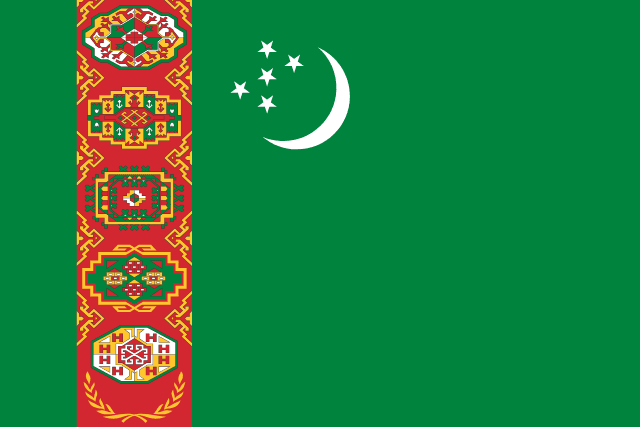
At a Glance
Alliances & Memberships
- Non-Aligned Movement (NAM)
- Economic Cooperation Organization (ECO)
- Commonwealth of Independent States (Associate Member)
- Organization of Turkic States (Observer status)
- Shanghai Cooperation Organization (Guest attendee)
- United Nations (UN)
Foreign Policy Overview
Turkmenistan adheres to the doctrine of 'Permanent Neutrality,' officially recognized by UN General Assembly Resolution 50/80 in 1995. This policy mandates non-interference, non-participation in military blocs, and avoidance of foreign military bases on its soil. Its posture is isolationist yet pragmatic regarding energy exports, primarily focused on diversifying gas pipelines (TAPI, Caspian Sea projects) to reduce dependence on Russia and China. Relations with neighbors focus on regional stability in Afghanistan to protect infrastructure. The state avoids collective security treaties like the CSTO to maintain its 'Positive Neutrality' status.
Key Positions on Major Issues
Climate: Prioritizes methane emission reduction (Global Methane Pledge) and desertification mitigation; seeks international technology transfers for green energy. Security: Absolute opposition to regional military escalations; promotes the 'Dialogue is a Guarantee of Peace' initiative; strictly neutral on the Ukraine-Russia conflict. Human Rights: Maintains that domestic policies are internal affairs; rejects Western-style democratic reforms in favor of 'national traditions' and stability. Trade: Advocates for the development of the Lapis Lazuli corridor and the Trans-Caspian Gas Pipeline to bypass transit bottlenecks. Regional: Actively supports the TAPI (Turkmenistan-Afghanistan-Pakistan-India) pipeline as a tool for regional stabilization.
UN Voting Record Notes
Turkmenistan frequently 'abstains' or is 'absent' during high-profile UNGA votes regarding the Russia-Ukraine conflict to maintained neutrality. It consistently votes against country-specific human rights resolutions (e.g., regarding Iran or Syria) citing the principle of non-interference. It reliably supports resolutions promoting 'Permanent Neutrality' and international energy security.
Economy & Trade
GDP composition: Industry (45%), Services (42%), Agriculture (13%). Currency: Turkmen Manat (TMT). Major industries: Natural gas, oil, textiles, cotton. Exports include gas (over 80% of revenue), crude oil, and petrochemicals. Principal trade partners: China (largest gas purchaser), Russia, Turkey, Kazakhstan, and Afghanistan. The economy is heavily state-controlled with a fixed exchange rate and limited foreign investment outside the energy sector.
Military & Security
Total active personnel approx. 36,000. Military expenditure is roughly 3% of GDP. Doctrine is purely defensive. No nuclear weapons or WMD programs. Turkmenistan does not host foreign troops and is not a member of the CSTO or NATO's PfP in a combat capacity. Primarily focused on border security (especially the 800km border with Afghanistan) and protecting Caspian maritime assets.
Recent History
Following the death of long-time leader Saparmurat Niyazov in 2006, Gurbanguly Berdimuhamedov modernized the personality cult while maintaining strict state control. The 2010s saw massive investment in infrastructure (Avaza, Ashgabat Olympic Complex) fueled by gas exports. In 2022, a managed transition occurred as Serdar Berdimuhamedov won the presidency, signaling continuity. The country has navigated the collapse of the Soviet-era pipeline monopoly by shifting supply to China via the Central Asia–China gas pipeline.
International Memberships
- Permanent Neutrality Status (UN recognized)since 1995
Cornerstone of national identity and foreign policy doctrine.
- Economic Cooperation Organization (ECO)since 1992
Primary forum for regional economic and infrastructure coordination.
- Commonwealth of Independent States (CIS)since 2005 (Status change)
Maintains status as a 'consulting member' rather than a full member to preserve neutrality.
- Organization of Turkic States (OTS)since 2021 (Observer)
Leverages ethnic ties while maintaining observer status to avoid binding political commitments.
MUN Negotiation Profile
Non-Aligned / Neutral Central Asian States
Formal, cautious, and strictly adherent to sovereign non-interference; prefers bilateral over multilateral oversight.
- Violation of Permanent Neutrality status or pressure to join military alliances.
- International interference in internal governance or human rights records.
- Restrictions on the sovereign right to manage and export natural resources.
- Any resolution mandating the presence of foreign military observers or bases.
- "As a permanently neutral state, Turkmenistan serves as a bridge for dialogue, not a platform for division."
- "We emphasize that energy security is inseparable from global stability, and Turkmen gas stands ready to power international peace."
- "National sovereignty is the bedrock of the UN Charter; we reject any attempt to use human rights as a tool for political intervention."
- "Sustainable development in Central Asia depends on the realization of the TAPI pipeline and the respect for our ecological boundaries."
- "Turkmenistan calls for the institutionalization of the 'Dialogue is a Guarantee of Peace' philosophy within all UN deliberations."