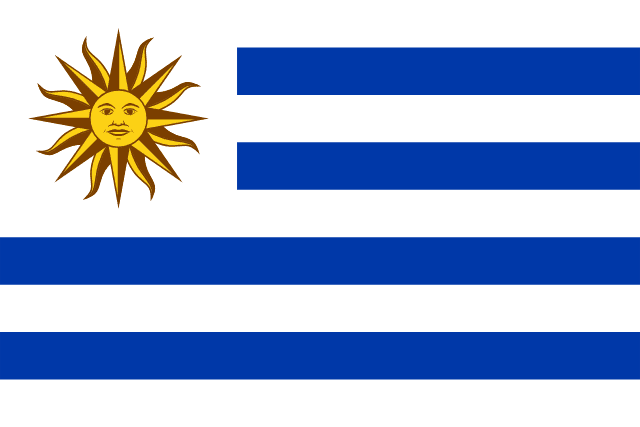
At a Glance
Alliances & Memberships
- UN
- OAS
- Mercosur
- CELAC
Foreign Policy Overview
Stable democracy; left-wing Frente Amplio returning; Mercosur reform; balanced foreign policy; UNHRC advocate.
Key Positions on Major Issues
Multilateralism; human rights; cannabis legalization; climate; pro-Palestine humanitarian.
UN Voting Record Notes
Generally Western-aligned with progressive lean.
Economy & Trade
Uruguay has a high-income, services-oriented economy with strong agriculture, livestock, forestry, logistics, software, finance, and renewable energy sectors. The Uruguayan Peso (UYU) is the national currency. Key exports include beef, soybeans, cellulose, dairy products, rice, and software services, while imports include fuel, machinery, chemicals, and vehicles. Major partners include China, Brazil, Argentina, the European Union, and the United States. Uruguay's economic diplomacy emphasizes stable institutions, green electricity, investment predictability, Mercosur flexibility, and access to wider markets beyond the customs bloc.
Military & Security
Uruguay's armed forces are small and professional, with army, navy, and air force branches focused on territorial defense, maritime security, disaster response, and international peacekeeping. Defense spending is modest, and the country has no nuclear weapons or WMD programs. Uruguay is one of the world's notable per-capita contributors to UN peacekeeping, using deployments to support multilateral credibility and military professionalism. Security priorities include maritime surveillance in the South Atlantic, cyber resilience, organized crime, and support to civilian authorities during emergencies.
Recent History
After the end of military rule in 1985, Uruguay consolidated one of Latin America's strongest democracies with peaceful alternation of power and high institutional trust. The Frente Amplio governed from 2005 to 2020, expanding social protections, legalizing same-sex marriage and cannabis, and advancing progressive rights agendas. A center-right coalition under Luis Lacalle Pou governed from 2020 to 2025, emphasizing fiscal restraint, security, and Mercosur reform. Yamandú Orsi's 2025 inauguration marked the Frente Amplio's return, likely sustaining Uruguay's pragmatic, rights-focused, and institutionally stable foreign policy while addressing crime, inequality, and regional trade constraints.
International Memberships
- United Nationssince 1945
Founding member and major contributor to UN peacekeeping operations.
- Organization of American Statessince 1948
Uses hemispheric institutions to defend democracy, rights, and rule of law.
- Mercosursince 1991
Founding member seeking greater flexibility for external trade agreements.
- CELACsince 2011
Participates in Latin American and Caribbean political coordination.
- World Trade Organizationsince 1995
Supports rules-based trade and market access for agricultural exports.
MUN Negotiation Profile
Latin American democratic middle power / Mercosur / progressive multilateralist.
Calm, legalistic, and bridge-building; often advances human-rights and rules-based language without aggressive rhetoric.
- Undermining democratic institutions or human rights protections.
- Trade rules that block agricultural exporters from fair market access.
- Weakening UN peacekeeping mandates without protecting civilians.
- Climate policies that ignore middle-income countries' adaptation and transition costs.
- "Uruguay believes small democracies can defend international law by applying it consistently, not selectively."
- "Open, rules-based trade is essential for food producers and for global food security."
- "Peacekeeping must protect civilians while maintaining legitimacy, accountability, and host-state cooperation."
- "Human rights and democratic institutions are not regional preferences; they are universal commitments."